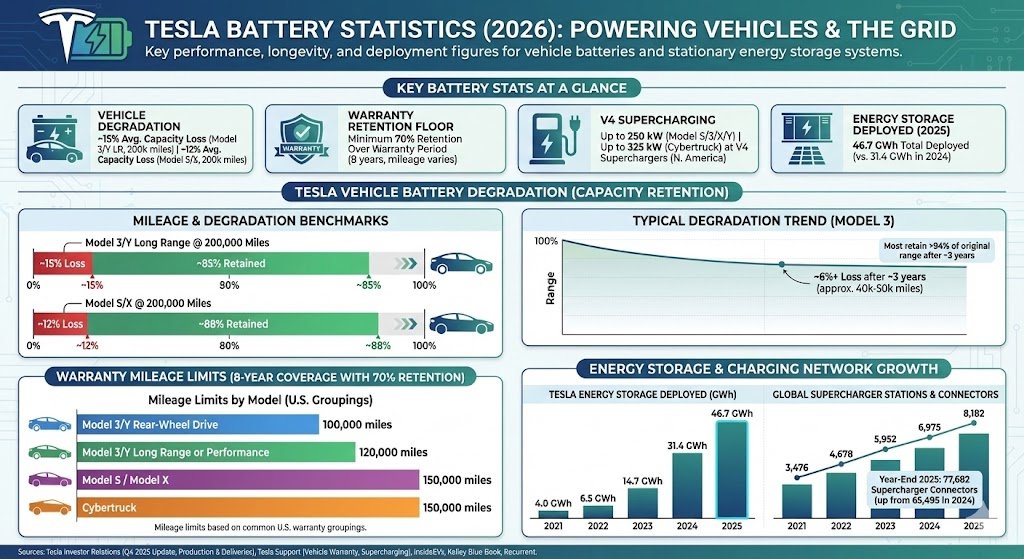
This page highlights Tesla battery statistics across vehicle batteries (degradation, warranty, fast charging) and stationary storage (Megapack/Powerwall deployments).
tesla battery statistics
Key Tesla battery stats at a glance
Model 3/Y Long Range degradation: Tesla has reported about 15% average capacity loss after 200,000 miles (≈ 85% retained).
Model S/X degradation: Tesla has reported about 12% average capacity loss after 200,000 miles (≈ 88% retained).
Warranty retention floor: Tesla’s Battery & Drive Unit warranty includes minimum 70% retention over the warranty period (coverage is 8 years, with mileage limits depending on model/trim).
V4 Supercharging (North America): Tesla states V4 can deliver up to 250 kW for Model S/3/X/Y and up to 325 kW for Cybertruck (at V4 Superchargers).
Energy storage deployed: Tesla reported 46.7 GWh deployed in 2025 (vs. 31.4 GWh in 2024).
Degradation is typically measured as capacity loss over time and mileage. Real-world range can also vary due to temperature, speed, tires, elevation, and software estimates, so treat these as benchmarks.
Metric
Statistic
What it implies
Model 3/Y Long Range @ 200,000 miles
~15% average capacity loss
~85% retained on average
Model S/X @ 200,000 miles
~12% average capacity loss
~88% retained on average
Model 3 after ~3 years (typical)
Most retain >94% of original range
~6%+ loss after ~40k–50k miles for many drivers
Chart: Tesla Battery & Drive Unit warranty mileage limits
Note: Tesla lists multiple trims and regions; mileage limits below are common U.S. groupings shown on Tesla’s warranty page.
Label
Bar
Value
Model 3/Y Rear-Wheel Drive
100,000 miles
Model 3/Y Long Range or Performance
120,000 miles
Model S / Model X
150,000 miles
Cybertruck
150,000 miles
Max = 150,000 miles. Widths: Model 3/Y Rear-Wheel Drive 66.67%, Model 3/Y Long Range or Performance 80.00%, Model S / Model X 100.00%, Cybertruck 100.00%.
Charging network stats that shape battery usability
Battery performance matters more when paired with convenient charging access. Tesla reports annual Supercharger network expansion in its quarterly update materials.
Tesla also reported 77,682 Supercharger connectors at year-end 2025 (up from 65,495 at year-end 2024).
Sources
Tesla Investor Relations — TSLA Q4 2025 Update (Operational Summary tables for storage deployed, Supercharger stations/connectors): https://assets-ir.tesla.com/tesla-contents/IR/TSLA-Q4-2025-Update.pdf
Tesla Investor Relations — Tesla Fourth Quarter 2025 Production, Deliveries & Deployments (FY 2025 storage deployments): https://ir.tesla.com/press-release/tesla-fourth-quarter-2025-production-deliveries-deployments
Tesla Support — Vehicle Warranty (8-year battery warranty terms and 70% retention language): https://www.tesla.com/support/vehicle-warranty
Tesla Support — Supercharging (V4 250 kW for S/3/X/Y; 325 kW for Cybertruck at V4 in North America): https://www.tesla.com/support/charging/supercharging
InsideEVs (Tesla-reported Model 3/Y Long Range ~15% capacity loss at 200,000 miles): https://insideevs.com/news/723734/tesla-model-3y-battery-capacity-degradation-200000miles/
Kelley Blue Book (Tesla-reported Model S/X ~12% capacity loss at 200,000 miles): https://www.kbb.com/car-news/tesla-our-batteries-lose-only-12-of-their-range-after-200000-miles/
Recurrent (most Model 3 batteries maintain >94% of original range after ~3 years / ~40k–50k miles): https://www.recurrentauto.com/questions/how-much-battery-degradation-should-i-expect-in-my-tesla-model-3-after-the-first-three-years